Figuring out how to write a cover letter when you're changing careers can feel like trying to solve a puzzle. The secret isn't just listing your skills—it's about reframing your entire professional story. You need to show a future employer how your past experiences, even the seemingly unrelated ones, are the perfect solution to their problems.
Your goal is to build a narrative that makes your career pivot feel less like a random leap and more like a smart, logical next step.
Why a Great Cover Letter Is Your Secret Weapon

Staring at that blinking cursor, wondering how to connect your decade as a teacher to a new life in tech? You’re not the only one. For career changers, a resume often tells a confusing story. It’s a collection of job titles and duties that, on the surface, might look completely disconnected from where you want to go.
That disconnect is a huge problem. It’s a fast track to rejection from both Applicant Tracking Systems (ATS) and the busy hiring managers who spend just seconds scanning applications. They're pattern-matching, and your non-traditional background doesn't fit the expected mold.
This is exactly where your cover letter becomes your most powerful asset.
A resume is the what and the where of your career. A career change cover letter is the why and the how. It’s your chance to provide context, show your personality, and make a human connection that a list of bullet points just can’t deliver.
Bridge the Gap and Control Your Narrative
Think of your cover letter as the bridge connecting your old career to your new one. It’s your one shot to control the narrative, connect the dots for the recruiter, and prove your genuine passion for this new field. A generic template won’t work here. You need a tailored story that reframes your experience as a unique advantage.
For instance, I've seen these pivots work time and again:
- A retail manager moving into project management highlights their knack for managing budgets, coordinating teams, and wrestling with unexpected logistical nightmares.
- An attorney shifting to a user experience (UX) role emphasizes deep skills in research, empathy, and advocating for a client's (or user's) needs.
- A hospitality pro applying for a customer success job showcases their expertise in building relationships, solving problems under pressure, and keeping clients happy.
Why It Still Matters in a Digital World
You’ve probably heard someone say cover letters are dead. For career changers, that’s just plain wrong. A 2024 survey of 625 hiring managers found that 45% always read cover letters, and another 38% usually do.
But here’s the real kicker for your journey: 82% of those managers admitted a strong cover letter could convince them to interview a candidate who doesn’t have direct experience.
Imagine you're moving from operations to marketing. Without a cover letter, your resume gets flagged for 'lacks direct experience.' But with one? You can explain how you’ve already been doing marketing-adjacent work, and suddenly, you’re a compelling candidate.
To give you a clearer picture, here's how the focus needs to shift from a standard application to one for a career pivot.
Traditional vs. Career Change Cover Letter Focus
| Element | Traditional Cover Letter | Career Change Cover Letter |
|---|---|---|
| Opening Hook | Highlights direct experience and alignment with the role. | Captures attention with a compelling "why" for the change. |
| Core Narrative | Proves proficiency through a history of similar roles. | Connects disparate experiences to the new role's core needs. |
| Skills Emphasis | Focuses on deepening existing, directly relevant skills. | Showcases transferable skills (e.g., communication, problem-solving). |
| Proof Points | Uses metrics from identical tasks (e.g., "Increased sales by 15%"). | Uses metrics to demonstrate transferable abilities (e.g., "Managed a $2M budget"). |
| Closing Statement | Reinforces fit and enthusiasm for the specific company. | Reaffirms commitment to the new field and unique value proposition. |
This table makes it clear: you’re not just applying for a job; you’re making a case for a new direction.
Your non-traditional background isn't a weakness—it's a source of unique perspective and diverse skills. This guide will give you a clear framework for building that bridge, starting with how to decode the job description to find your angle. Crafting these powerful, evidence-backed narratives is a core part of what we do at https://rolestrategist.com/, where our services help job seekers turn their past experience into their greatest asset.
Decoding the Job Description for Your Unique Angle
Before you even think about writing your cover letter, you need to put on your detective hat. The job description is your first and most important piece of evidence. Most people just give it a quick scan, hunting for keywords to sprinkle into their resume. They treat it like a checklist.
That’s a huge mistake.
A job description isn't just a shopping list of tasks; it’s a distress signal. It’s a map to the company’s biggest problems—the ones they’re desperate to solve. Your mission is to find those problems and position yourself as the solution.
Forget trying to address everything. Instead, narrow your focus to the two or three most critical needs you uncover. This focused approach becomes the foundation of your entire narrative, shifting your cover letter from a generic plea to a targeted, problem-solving pitch.
Find the Pain Behind the Bullet Points
Companies write job descriptions when they have a problem they can’t fix with their current team. Maybe projects are slipping, customers are unhappy, or a new system is causing chaos. Your job is to read between the lines and diagnose their pain.
Look for words that signal urgency, frustration, or a cry for help:
- Action verbs: "oversee," "drive," "implement," "streamline," "resolve."
- Adjectives: "fast-paced," "high-pressure," "complex," "cross-functional."
- Repetition: If a phrase like "stakeholder communication" shows up three times, it’s not a suggestion. It’s a five-alarm fire.
Think of it this way: a listing for a Project Manager might ask for "experience with Agile methodologies." A surface-level read says, "Okay, I'll mention Agile." A deeper read asks, Why do they need Agile? The answer is probably because their projects are a mess, deadlines are constantly missed, and their teams aren't talking to each other.
That’s the real problem you need to solve.
A Real-World Example: The Project Manager Role
Let’s walk through a common scenario. A career changer coming from a non-profit event planning background sees a posting for a Project Manager at a growing tech startup. It’s easy to feel discouraged. But let's look closer at the clues in the job description.
Job Description Excerpt:
- "Manage multiple, concurrent project timelines in a dynamic environment." (Translation: "It's chaotic here, and we need someone to bring order.")
- "Serve as the primary liaison between engineering, marketing, and executive leadership." (Translation: "Our teams are in their own worlds and don't communicate.")
- "Proven ability to mitigate risks and manage stakeholder expectations." (Translation: "Our clients and our bosses get angry when things go wrong, and it's happening a lot.")
The event planner doesn’t have "tech project management" on their resume, but they’ve been solving these exact problems for years. They've juggled dozens of vendors, sponsors, and volunteers (stakeholders), coordinated marketing and logistics (cross-functional communication), and handled every last-minute crisis imaginable (risk mitigation).
Your unique angle is found where their biggest problem overlaps with your proven, transferable success. Your cover letter’s job is to build a bridge directly between those two points.
This kind of strategic decoding is the most important thing you can do. It flips your mindset from, "Do I have the right experience?" to "How have I already solved this company's problem, just in a different context?"
Connecting Your Past to Their Future
Once you’ve identified their core problems, you can frame your experience as the exact solution they need. For our event planner, the narrative isn't about planning galas; it's about delivering complex projects under pressure.
Their cover letter can now tell specific stories that hit the mark:
- Orchestrating Chaos: They can share a story about managing a fundraiser with 20+ vendors on a tight budget, proving they can handle "concurrent project timelines."
- Unifying Teams: They can describe how they got the marketing team's promotional schedule to align perfectly with the logistics team's on-site plan, showing they can be a "primary liaison."
- Managing Expectations: They can provide an example of a major sponsor pulling out at the last minute and how they calmed everyone down and secured a replacement, demonstrating true "risk mitigation."
This process is absolutely fundamental to writing a career change cover letter that gets noticed. It's also something that can be systemized. The AI engine at RoleStrategist is built to do this decoding for you, analyzing job descriptions to pinpoint what an employer truly values. Our service gives you a clear roadmap so you can focus on telling your most powerful stories. After all, getting your application past the initial screening is key. For more on this, check out our guide on why so many resumes fail to pass ATS scans.
Crafting an Unforgettable Opening Paragraph

You have less than ten seconds to make an impression. Seriously. That’s about how long a hiring manager glances at your cover letter before deciding if it’s worth their time.
A generic opener like, "I am writing to apply for the Project Manager position..." is the fastest way to get your application tossed. For a career changer, that kind of start is a deal-breaker. You can't afford to sound like everyone else.
Your opening paragraph is your hook. It needs to make the reader stop, lean in, and think, "Okay, this person is different. I need to keep reading." This is your one shot to get ahead of their questions about your career change and frame it as your biggest strength.
The trick is to nail your "pivot story"—a quick, two-sentence narrative that connects your past experience directly to this new opportunity. It makes your career change feel intentional, logical, and exciting.
Go Beyond the Generic Opening
Forget the standard cover letter advice you've heard before. As a career changer, your introduction has to do three things, fast:
- Grab Attention: Lead with a specific, impressive achievement from your previous career.
- State Your Intention: Clearly name the role you're going for.
- Connect the Dots: Briefly explain why this pivot is the natural next step.
This approach shows you’re confident and that you see the clear connection between what you’ve done and what you can do for them.
The Power of a Pivot Story
Think of your pivot story as your elevator pitch, condensed into its most potent form. Let's break down how to build one. Imagine a teacher who wants to move into a Corporate Trainer role.
Before (The Generic Failure): "I am writing with great interest to apply for the Corporate Trainer position I saw advertised on LinkedIn. While my background is in education, I believe my skills are a strong match for this role."
This sounds apologetic and uncertain. It leads with what they think is a weakness ("my background is in education") and immediately puts the hiring manager on the defensive.
After (The Compelling Pivot Story): "Over the past eight years, I designed and implemented a new curriculum that improved student engagement scores by 35% across three grade levels. I am now eager to apply my expertise in instructional design and adult learning principles to drive employee development as your next Corporate Trainer."
See the difference? This version leads with a powerful, quantified achievement. It clearly states the target role and uses industry keywords like "instructional design" to build a seamless bridge from one career to the next. It’s confident, direct, and positions the teacher as an expert problem-solver.
Formulas for a Strong Opening
You don’t have to reinvent the wheel. Here are a couple of battle-tested formulas that work wonders for career changers:
- The Achievement Formula: "In my previous role as a [Your Old Title], I accomplished [Quantifiable Achievement]. I'm excited to bring this track record of [Relevant Skill] to the [New Role Title] position at [Company Name]."
- The Mission Connection Formula: "I have long admired [Company Name]'s commitment to [Specific Company Value or Mission]. My experience in [Your Old Field], where I [Action You Took that Aligns with Their Mission], has prepared me to contribute to this goal as your new [New Role Title]."
A powerful opening paragraph doesn't just state your interest; it begins to prove your value from the very first sentence. It replaces the recruiter's potential skepticism with genuine curiosity.
Hiring managers have seen it all, and they can spot a generic, copy-pasted letter a mile away. A ResumeGo survey found that 78% of hiring professionals can instantly identify a generic cover letter, and 81% give far more weight to a thoughtfully tailored one. For anyone changing careers, this isn't just a suggestion—it's the only way to get noticed. You can read more about the importance of tailored letters on Murray Resources.
Crafting these narratives for every single application takes time. The services at RoleStrategist are designed to help you quickly pinpoint what a company actually cares about and build a story that resonates. Our platform helps you organize your best achievements so you can deploy your strongest "pivot stories" with confidence, every time.
Translating Your Experience into Their Language
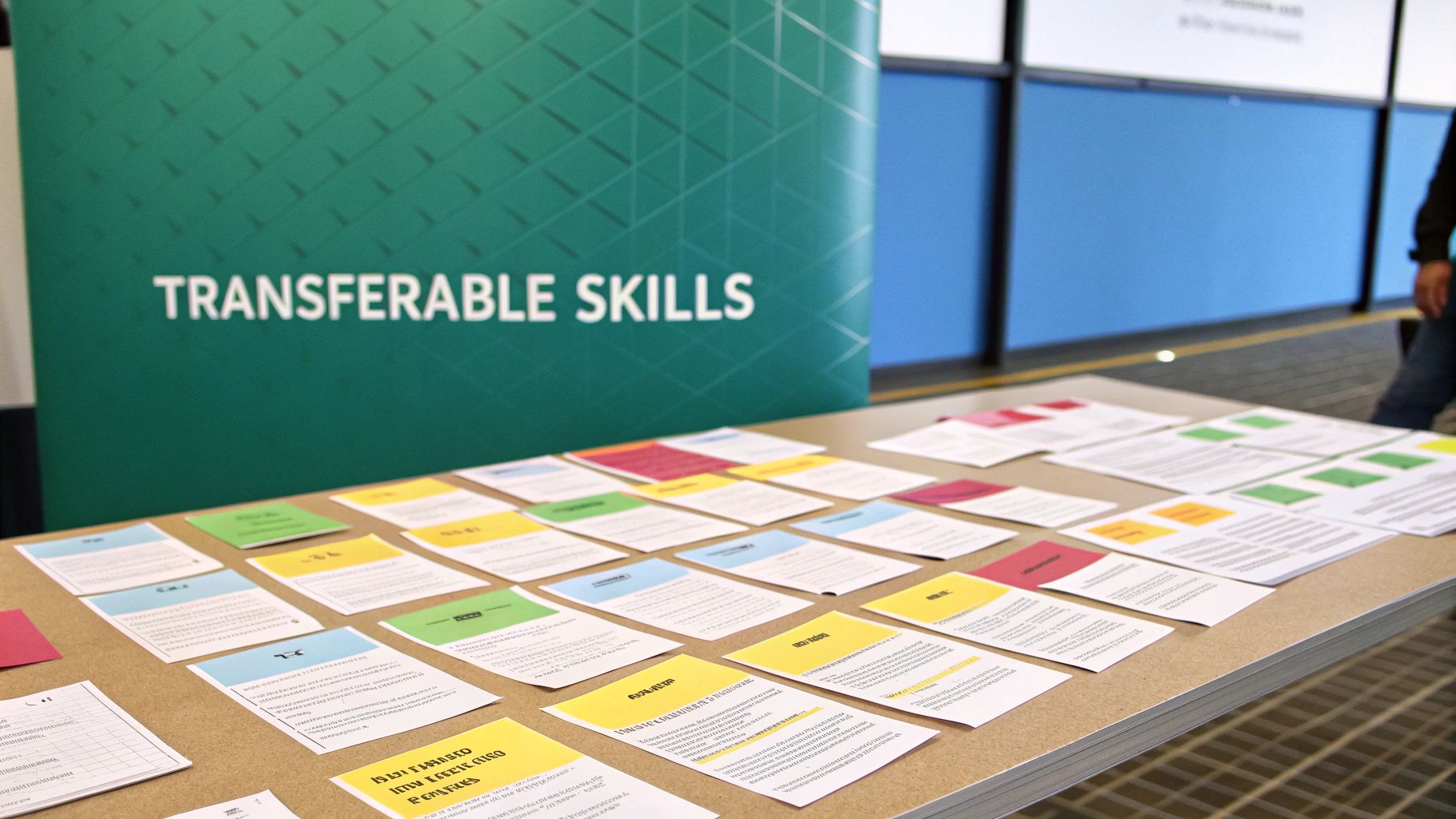
This is where the rubber meets the road. After a strong hook in your opening, the body of your cover letter needs to deliver undeniable proof that your past experience isn't just relevant—it's incredibly valuable.
Let's be blunt: listing skills like "strong communicator" or "team player" is a waste of space. These are empty claims every single applicant makes. Your job is to provide the hard evidence that forces the reader to conclude you're a strong communicator on their own.
Your goal is to show, not tell. The way you do that is by focusing on your top three or four transferable skills and backing each one up with a story of quantifiable success.
From Vague Claims to Compelling Proof
The single most effective way to frame your achievements is the Problem-Action-Result (PAR) method. It’s a simple storytelling structure that turns a bland statement into a compelling narrative of your direct impact.
It works like this:
- Problem: What was the challenge or business pain point?
- Action: What specific steps did you take to solve it?
- Result: What was the positive, measurable outcome of your actions?
Let’s see this in action. A common but weak statement is: "I have excellent project management skills." This means absolutely nothing to a recruiter.
But using the PAR method, that same idea becomes a powerful story:
(Problem) "Our marketing and sales teams were completely siloed, leading to inconsistent messaging and missed lead-nurturing opportunities. (Action) I implemented a shared project management system using Asana, creating a unified content calendar and leading weekly sync meetings to align both teams. (Result) Within one quarter, we saw a 20% increase in marketing-qualified leads and a 15% reduction in our sales cycle."
See the difference? This story doesn't just claim you can manage projects; it proves you use that skill to solve real business problems and generate tangible results.
Identifying Your Most Powerful Transferable Skills
Don't try to prove everything at once. Zero in on the core skills you found when you decoded the job description. These are usually things like stakeholder management, data analysis, client relations, or process improvement.
For each skill, think of a specific moment where you made a difference. Brainstorm times you:
- Saved money or time: "Reduced operational costs by $50,000 annually by..."
- Increased revenue or efficiency: "Improved team productivity by 25% by introducing..."
- Solved a complex problem: "Resolved a long-standing customer complaint issue that cut support tickets by 40%."
- Led a team or project: "Managed a cross-functional team of five to deliver the project two weeks ahead of schedule."
Quantifying your results is critical. Numbers cut through the noise and give your achievements weight. Even if you don't have exact figures, solid estimates like "streamlined a process that saved an estimated 10 hours per week" are far more powerful than generic claims.
The table below shows how you can translate experience from one field to another—a crucial step in crafting a cover letter that gets results.
Translating Your Experience Transferable Skills in Action
| Skill from Your Old Career | Example Achievement | How to Frame It for the New Career |
|---|---|---|
| Budget Management (Retail) | Managed an annual store budget of $2.5M, consistently meeting profitability targets. | "Expertise in resource allocation and financial oversight, demonstrated by managing a $2.5M operational budget." |
| Client Relations (Hospitality) | Increased positive guest reviews by 30% by creating a personalized follow-up system. | "Proven ability to enhance customer satisfaction, resulting in a 30% improvement in client feedback scores." |
| Curriculum Design (Education) | Developed a new science curriculum for 200+ students, leading to a 15% rise in test scores. | "Skilled in creating effective training programs; designed learning modules that improved user proficiency by 15%." |
This translation is where the magic happens. You’re not changing your history; you’re changing the language you use to describe it, aligning it perfectly with the vocabulary and priorities of your target industry.
Keeping track of all these proof points can be a real headache, especially when you're applying for multiple roles. This is precisely why we built the Evidence Library feature into RoleStrategist. Our services allow you to store all your best Problem-Action-Result stories in one central place.
When you're ready to write, our AI pulls from your library to weave your most relevant, evidence-backed achievements seamlessly into a powerful narrative. This ensures every cover letter you send is packed with undeniable proof of your value, tailored perfectly to the job you want.
Closing with Confidence and a Clear Call to Action

You’ve built a strong case for your career change, connecting your past experience to the company's future needs. Don't let a weak ending kill that momentum. Your final paragraph is your last, best chance to make an impression, so it needs to be confident and proactive.
Too many career changers fizzle out with something passive like, "Thank you for your time and consideration." That’s a conversation-ender. Your goal is to start one.
Think of your closing as an invitation. You need to summarize your value, show genuine excitement for the role, and clearly state what you want to happen next. This isn't about asking for an interview; it's about proposing a valuable discussion.
Crafting a Compelling Call to Action
A strong call to action gives the hiring manager a reason to talk to you. It's not just "I'd like to interview," but "Here's what we could accomplish together." This shifts the dynamic from you needing a job to them needing your skills.
Instead of a generic sign-off, try something more strategic that ties back to their needs.
- The Value Proposition Close: "I am eager to discuss how my experience streamlining supply chains can bring a new level of efficiency to your operations team."
- The Enthusiastic Follow-Up: "I've been following [Company Name]'s work in sustainable packaging and would welcome the opportunity to share how my background in materials science could support your upcoming initiatives."
- The Direct Problem-Solver: "I am confident my ability to manage complex stakeholder relationships can help resolve the cross-departmental communication challenges you've outlined. I look forward to discussing my approach with you."
Each of these examples is active, not passive. They point to a specific value you bring, which is the final piece of the puzzle in learning how to write a career change cover letter that actually gets you the interview.
Your closing statement should be a confident invitation to a strategic conversation. It’s the moment you transition from applicant to potential partner, proposing a discussion about how you can solve their specific problems.
The Final Polish Before You Hit Send
Once your story is complete, don't let a sloppy mistake undermine it. Small errors suggest a lack of attention to detail, which is a red flag for any hiring manager. Run through this quick checklist before you send anything.
Professional Sign-Offs No need to get creative here. Stick to the classics.
- Sincerely
- Best regards
- Respectfully
Follow this with your full typed name.
Contact Information Formatting Make it easy for them to contact you. Below your name, include:
- Your Phone Number
- Your Email Address
- A clean link to your LinkedIn profile
Proofreading Like a Pro Typos are application killers. Spellcheck will miss context errors (like "manger" instead of "manager"), so don't rely on it alone.
- Read it Aloud: This slows you down and helps you catch awkward phrasing your brain might otherwise skim over.
- Read it Backwards: Start with the last sentence and work your way to the top. This trick forces your brain to focus on individual words, making it much easier to spot typos.
- Get a Second Opinion: A fresh pair of eyes from a trusted friend or colleague will almost always catch something you missed.
These final touches ensure your letter is a polished, professional document. Taking an extra five minutes here can be the difference between getting an interview and getting ignored.
And if you want to be certain every letter is tailored and error-free, the services at RoleStrategist can help you generate compelling, evidence-backed narratives and review them for impact, so you can apply with total confidence.
Your Last-Minute Career Change Cover Letter Questions, Answered
As you get ready to hit "apply," it’s totally normal for a wave of last-minute questions and "what if" scenarios to pop up. Feeling a little uncertain is just part of making a big move. Getting clear, direct answers can give you that final shot of confidence you need.
Let's walk through some of the most common questions that come up when you're staring down the blank page.
What Do I Do About a Resume Gap?
Address it directly, keep it brief, and frame it as a positive. A resume gap only becomes a red flag if you treat it like one.
All you need is a sentence or two in your cover letter to explain it, then immediately pivot back to the value you bring.
For instance, if you stepped away for caregiving, you could write something like: "After dedicating two years to caring for a family member, I’m re-entering the workforce with renewed focus and energy. That experience sharpened my skills in project management and creative problem-solving, which I’m excited to bring to this role."
See? Simple, professional, and it turns a potential negative into a story of resilience.
How Much Personality Is Too Much?
This really hinges on the company culture, but a little personality is always a good thing. Your cover letter is your one real chance to make a human connection before an interview.
If the company's brand sounds casual and creative, feel free to lean into a more conversational tone. For more buttoned-up industries like finance or law, you'll want to keep it professional but still let your genuine enthusiasm for the role come through.
The goal isn't to be a stand-up comedian; it's to be memorable. A flash of your authentic self can make you stand out from a pile of generic applications and show the hiring manager there's a real person behind the resume.
Should I Mention I'm Okay With a Lower Salary?
Absolutely not. Never bring up salary in a cover letter unless the job posting explicitly tells you to.
Discussing compensation this early almost always weakens your negotiating position later on. It can also make you seem less confident in the value you offer. Right now, your entire focus should be on proving how your skills solve their problems.
Save the salary talk for later in the process, after you've already demonstrated just how much you're worth.
Can My Cover Letter Go Onto a Second Page?
Nope. Fight the urge. Your goal should be to keep your cover letter to a single page, which usually means somewhere between 250 and 400 words.
Hiring managers are swamped. A long, dense letter is more likely to get skimmed—or skipped—than read. Sticking to one page forces you to be sharp, clear, and impactful with your message, which is exactly what you want.
For more deep dives and practical tips on building a standout application, feel free to explore other articles on the RoleStrategist blog.
Made with the Outrank tool