When you hear "tailor your resume," it's not just a buzzword. It means strategically rewriting your summary, skills, and work history to directly reflect the language and qualifications from the job description.
The whole point is to make sure your resume sails through automated screeners and, more importantly, lands in front of a real person who immediately thinks, "This is the one."
Why Your Generic Resume Isn't Working

It’s incredibly frustrating to get a string of rejection emails—or worse, silence—when you know you’re a great fit for the role. If you’re sending the same resume out for every application, you’ve probably learned the hard way that the ‘one-size-fits-all’ approach is officially dead.
Today’s hiring is all about speed and technology. Generic applications just don't stand a chance.
The first hurdle is the digital gatekeeper. Most companies use an Applicant Tracking System (ATS) to handle the sheer volume of applications they receive. These bots are programmed to scan for specific keywords and phrases pulled directly from the job description. If your resume doesn't use that exact language, it gets tossed out before a human ever lays eyes on it.
The Human Element
Let's say your resume makes it past the bots. Great. Now it faces an even tougher challenge: a real-life recruiter who spends a mere six to eight seconds on the initial scan.
In that tiny window, they're not reading every word. They're hunting for immediate proof that you have what they need. A generic resume makes them dig for that proof. A tailored one puts it right in front of them.
This is why learning how to tailor your resume to a job description isn't just a helpful tip—it’s the single most important thing you can do. Stop thinking of it as a chore and start seeing it as a strategy. Every application is a new opportunity to position yourself as the perfect solution to that company's specific problem.
Tailoring your resume is the difference between hoping a recruiter connects the dots and drawing the picture for them. It’s about making their job easy, which makes you an easy choice for an interview.
The impact of this approach is huge. A single corporate job opening can easily attract 250 applicants. In that kind of competition, being “good enough” isn’t enough. You have to be the obvious choice.
And consider this: studies show that up to 75% of resumes are rejected by ATS software purely because they don't align with the job description's keywords. Customizing your resume is your ticket past the bots and into the "yes" pile. To really get a feel for the numbers, you can explore more resume statistics that shape modern hiring.
At the end of the day, a successful job search is about strategy, not just volume. At RoleStrategist, we built our entire platform on this reality—helping you decode job descriptions and reframe your experience to land with maximum impact, every single time.
How to Read a Job Description Like a Recruiter

Every job description is a cheat sheet. It’s a blueprint laying out exactly what a company needs, what problems they’re trying to solve, and what language they use internally. But most people just skim them.
To get ahead, you need to stop reading like a candidate and start analyzing like a recruiter. Think of it as decoding a puzzle where every word is a clue pointing to what really matters. This is the foundation of a resume that doesn't just get seen—it gets results.
Deconstructing the Job Post
Before you write a single word, get your hands dirty. Print the job description or pull it into a document where you can highlight, comment, and tear it apart. Your mission is to separate the critical signals from the generic noise.
A simple color-coding system works wonders here. It turns a wall of corporate-speak into a clear visual map of the company's priorities.
- Hard Skills (Color 1): These are the non-negotiables. For a Product Marketing Manager, you're looking for phrases like "SEO," "market analysis," or "Salesforce." These are the technical and functional abilities they need on day one.
- Soft Skills (Color 2): These clues reveal how they expect you to work. Hunt for terms like "stakeholder management," "cross-functional collaboration," or "strong communicator." These are just as important as the hard skills.
- Company Language (Color 3): Pay very close attention to repeated or unique phrases. Do they keep mentioning a "growth mindset" or being "customer-obsessed"? That’s their cultural DNA. Mirroring it in your resume shows you’ll fit right in.
This manual breakdown is exactly what powerful tools like RoleStrategist automate, giving you an instant analysis of what the employer really wants.
Creating Your Keyword Analysis Table
Once you've highlighted the key terms, it's time to translate them into your own experience. Don't just make a mental note; build a quick table to map their needs directly to your accomplishments. This forces you to connect the dots between your past and their future.
Here's a look at how you can break down a typical job description into actionable insights.
Job Description Keyword Analysis
| Category | Keyword/Phrase from Job Description | What It Really Means |
|---|---|---|
| Core Responsibility | "Develop and execute go-to-market strategies" | They need someone who can own a product launch from start to finish. |
| Collaboration | "Manage cross-functional stakeholder relationships" | You'll be working with Engineering, Sales, and Support—and need to prove you can. |
| Methodology | "Leverage data-driven insights to inform campaigns" | Show me the numbers. They want proof you don't just guess. |
| Tooling | "Proficiency in Salesforce and Marketo" | These are must-have tools for their team; you need them listed on your resume. |
| Company Culture | "Thrive in a fast-paced, results-oriented environment" | They're signaling that they prioritize speed and measurable outcomes. |
This isn't just about beating an Applicant Tracking System. It’s a strategic exercise that forces you to articulate your value in the exact language the hiring manager understands.
Instead of just listing what you've done, you're showing precisely how your background solves their specific problems. That shift in perspective is the secret to a resume that truly stands out.
Transforming Your Resume to Match Employer Needs
With your keyword map complete, it's time to shift from analysis to action. This is where the magic happens—where you stop thinking like a historian listing old jobs and start acting like a marketer selling a solution.
You’re about to transform your resume from a generic document into a targeted pitch. It’s not about just dropping in a few keywords. We're going to reframe your accomplishments, your skills, and even your professional summary to speak the employer’s exact language.
Revamping Your Professional Summary
Your professional summary is the headline. It's the first thing a recruiter sees, and it has about five seconds to convince them you’re a serious contender. A generic summary is an instant turn-off.
Let's imagine you're applying for a 'Product Marketing Manager' role that keeps mentioning "go-to-market strategies" and "data-driven insights."
- Before: Experienced marketing professional with a history of developing successful campaigns and managing product launches. Seeking a challenging new role in a dynamic company.
- After: Data-driven Product Marketing Manager with 5+ years of experience leading successful go-to-market strategies for B2B SaaS products. Proven ability to leverage market analysis and user insights to drive product adoption and exceed revenue targets.
See the difference? The "After" version is powerful because it immediately mirrors the job description’s language and backs it up with specific context (B2B SaaS, revenue targets). It screams, "I am the person you're looking for."
Quantifying Your Impact with the STAR Method
Your work history section is where you prove you can do the job. Each bullet point is a golden opportunity to demonstrate your value. Just listing your old duties is a huge mistake. You need to showcase your achievements.
The STAR method (Situation, Task, Action, Result) is a fantastic framework for this. It forces you to connect what you did with why it mattered.
- Situation: Briefly describe the context. What was the challenge?
- Task: What was your specific responsibility?
- Action: Detail the steps you took, making sure to weave in keywords from the job description.
- Result: This is the most important part. Quantify the outcome with numbers, percentages, or tangible improvements.
Your goal is to translate every responsibility into a measurable achievement. Instead of saying you "managed social media," explain how you "grew organic engagement by 35% in six months by implementing a new content strategy."
This is the real work of resume tailoring, and it’s what separates the top candidates from everyone else. And the data backs it up: 63% of recruiters say they prefer a resume customized to the open position. While only 8% of job titles naturally include metrics, adding numbers to your accomplishments can increase your chances of getting an interview by a whopping 40%. You can dig deeper into this data with Enhancv's detailed resume statistics.
Weaving Keywords into Your Experience
Now, let's put it all together. Let’s say the job description repeatedly asks for "cross-functional collaboration."
- Before: Worked with the engineering and sales teams on product launches.
- After: Led cross-functional collaboration between Product, Engineering, and Sales teams to launch a new feature, resulting in a 15% increase in user activation within the first quarter.
The second bullet point is a masterclass in resume tailoring. It uses the exact keyword phrase, follows the STAR format, and—most importantly—proves the skill with a hard number. It doesn't just claim you can collaborate; it shows the successful outcome of that collaboration.
Crafting these data-backed bullet points can feel like a grind, but it’s absolutely essential for getting noticed. This is precisely the kind of heavy lifting that tools like RoleStrategist are built for, offering AI-powered suggestions that help you perfectly align your real achievements with what an employer wants to see.
Your Checklist for Beating the Resume Robots
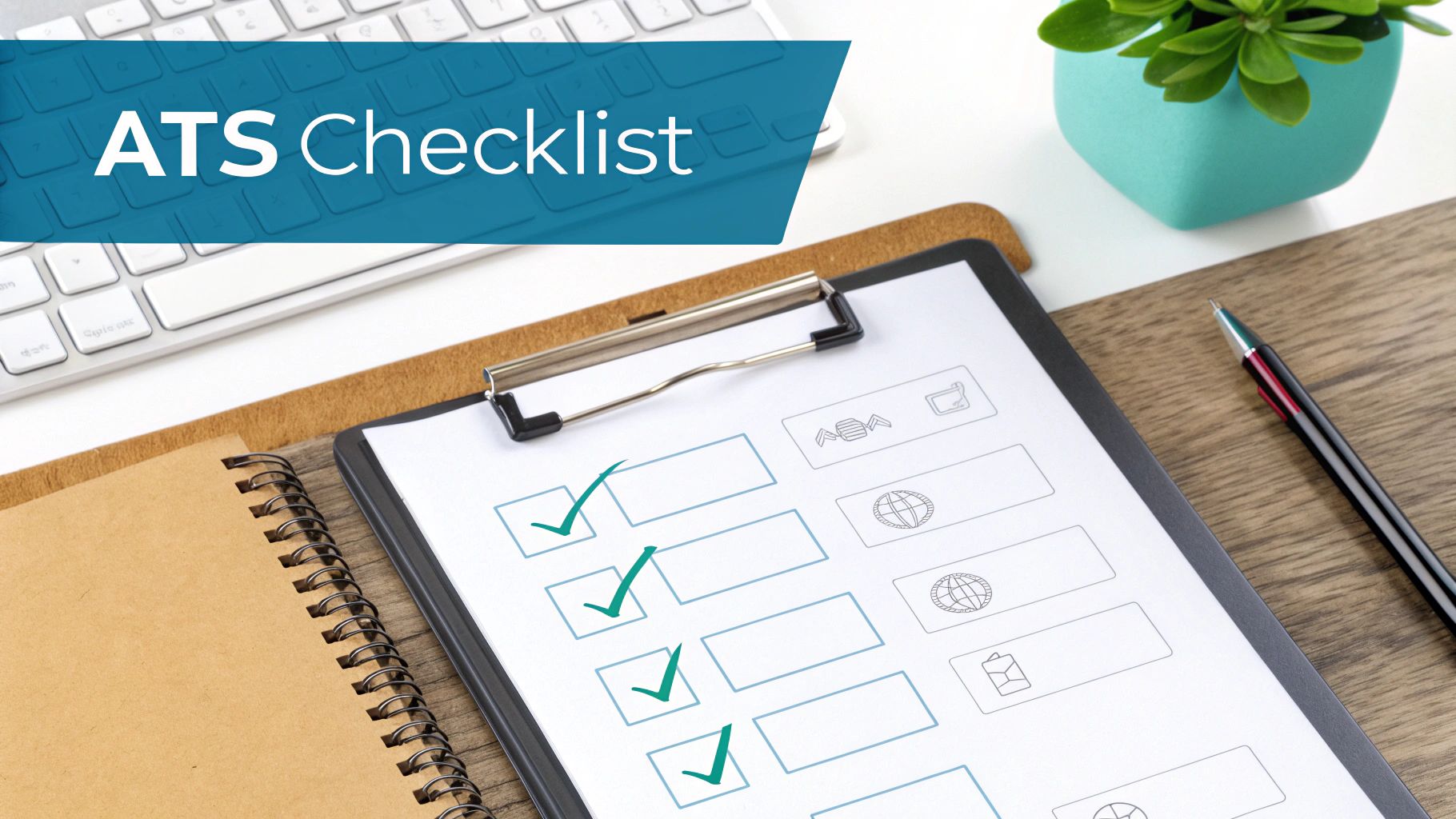
After all the hard work weaving keywords and metrics into your experience, it’s time for a final pre-flight check. This last step is purely technical, ensuring your carefully crafted resume doesn't get scrambled by an Applicant Tracking System (ATS).
Getting past these digital gatekeepers isn't a dark art; it’s a game with clear rules. Success here has less to do with creative genius and more to do with clean, predictable formatting.
Think of the ATS as a very literal-minded robot. It gets confused by fancy graphics, columns, or clever section titles. It needs simple, standard formatting to pull your information correctly. If you stray too far from the norm, key parts of your experience might as well be invisible.
This checklist will help you sidestep the common traps that get perfectly good resumes kicked out before a human ever lays eyes on them.
Master Your Headings and File Type
It's the simplest things that often make the biggest difference. An ATS needs to know exactly where to find your work history, skills, and education. Don't make it guess.
- Use Standard Section Titles: Always stick to conventional headings like "Work Experience" or "Professional Experience." Avoid creative but confusing titles like "My Career Journey." The same goes for "Skills" and "Education." The software is literally programmed to look for these specific words.
- Choose the Right File Type: Unless the application explicitly asks for a PDF, a .docx file is your safest bet. Some older ATS platforms still struggle to read PDFs correctly, especially if they have complex formatting, which can turn your resume into a jumbled mess.
Keep Your Formatting Simple and Clean
A visually stunning resume might wow a human, but it can completely baffle a bot. When it comes to ATS compatibility, simplicity wins every time.
Your goal is a document that's easy for both software and people to read. Clean formatting ensures the ATS extracts your data accurately, while a human recruiter can quickly scan for the qualifications that matter.
Here's a quick rundown of the most important formatting rules:
- Avoid Tables and Columns: Most ATS parsers read from left to right, top to bottom. If you use columns, the system might mash the text from both sides together into an unreadable string of nonsense.
- Stick to Standard Fonts: Play it safe with common, web-safe fonts like Arial, Calibri, or Times New Roman. Stay away from script or decorative fonts that the software might not recognize.
- Use Standard Bullets: Simple, solid circles or squares are your best friends. Avoid fancy arrows, checkmarks, or other custom symbols that the system could misinterpret or ignore entirely.
- Handle Acronyms the Right Way: The first time you use an industry-specific acronym, write out the full term and place the acronym in parentheses right after. For example, "Search Engine Optimization (SEO)." This guarantees the ATS catches both versions, maximizing your keyword score. For a deeper dive, you can learn more about why some resumes fail the ATS scan in our detailed guide.
To help you remember these critical points, here’s a quick-reference table.
ATS Do's and Don'ts
| Do | Don't |
|---|---|
| Use standard headings like "Work Experience." | Use creative headings like "My Professional Story." |
| Submit a .docx file unless a PDF is required. | Assume every system can read a PDF perfectly. |
| Stick to a single-column layout. | Use tables, text boxes, or multi-column layouts. |
| Use simple, universal fonts (Arial, Calibri). | Use custom fonts, scripts, or decorative styles. |
| Use standard round or square bullet points. | Use checkmarks, arrows, or other special symbols. |
| Write out acronyms first: CRM (Customer Relationship Management). | Use acronyms without defining them first. |
Following these guidelines removes any potential technical roadblocks that could get in your way.
This final check is a crucial last step that platforms like RoleStrategist actually integrate into their analysis, flagging formatting issues that could sink your chances. By getting these details right, you ensure your carefully tailored content gets delivered intact and makes the impact you intended.
Common Resume Tailoring Mistakes to Avoid
Learning to match your resume to a job description is a game-changer. But it’s surprisingly easy to get wrong, and a few common missteps can turn a promising application into an instant rejection. You have to know what not to do.
The single biggest mistake is confusing tailoring with fabricating. Your goal is to reframe your real experience using the employer’s language, not to invent skills you don't possess. Honesty is everything. Your resume has to be an authentic reflection of what you've actually done.
Another pitfall I see all the time is over-optimization. This is when you focus so much on cramming in keywords that your resume starts sounding like a robot wrote it. It loses its human touch. Remember, a person will eventually read your resume, and they need to connect with your story, not just a list of buzzwords.
Misguided and Ineffective Shortcuts
In a rush to apply, many job seekers grab onto shortcuts that feel productive but don't actually move the needle.
- The Summary-Only Tweak: Just updating your professional summary and calling it a day is a classic mistake. Real alignment means weaving those key concepts and achievements throughout your entire work history and skills sections.
- Generic AI Overhauls: Letting a basic AI tool rewrite your whole resume can be a disaster. Recruiters are getting sharp at spotting generic, soulless documents. In fact, 62% of hiring managers say they've rejected resumes they suspected were written by AI without any real human touch.
- Keyword Stuffing: Jamming every keyword from the job description into your resume is an old-school tactic that no longer works. Modern ATS can flag this unnatural practice, and it makes your resume completely unreadable for the hiring manager.
The Real Cost of a Generic Application
Failing to properly customize your application isn't just a missed opportunity—it's the main reason most resumes get ignored in the first place. Time and again, recruiters point to a lack of customization as their biggest pet peeve.
In a competitive market, a generic resume isn’t just overlooked; it’s actively filtered out. It tells the hiring manager you're not genuinely interested and didn't bother to put in the effort.
The stats are pretty clear on this. A staggering 55% of recruiters name "failure to tailor a resume" as the top mistake job seekers make, ranking it even higher than typos. Now, consider that 75% of resumes are rejected by an ATS before a human even sees them. A generic application just doesn't stand a chance. You can dig into more of this data on Qureos.com's career guide.
The trick is finding that sweet spot between satisfying the ATS and impressing a human reader. This is where a smart platform like RoleStrategist comes in, guiding you to keep your story authentic while making sure every word is placed for maximum impact.
Common Questions About Tailoring Your Resume
Once you start customizing your resume for specific roles, a few practical questions always come up. Here are some quick answers to the things I hear most often from job seekers.
How Much Time Should I Really Spend on Each Application?
This is a big one. The idea of tailoring every single resume sounds exhausting, but it's more efficient than you think. Once you have a solid master resume to work from, you should be able to knock out a tailored application in about 30-60 minutes.
Honestly, it gets much faster with practice.
That initial time investment is what gets you a higher interview rate. It saves you from the soul-crushing experience of sending hundreds of generic resumes into a black hole. It’s about working smarter, not harder.
Is It Okay to Leave Irrelevant Experience Off My Resume?
Absolutely. In fact, you should. A tailored resume is a marketing document, not your life story. Its only job is to prove you're the best fit for this specific role.
Recruiters are sifting through dozens, sometimes hundreds, of applications. They appreciate a focused resume that gets straight to the point. A sharp, one-page document packed with relevant skills and quantified wins is always more compelling than a three-page epic that makes them hunt for the good stuff.
Don't be afraid to trim the fat. If a past role or a specific duty doesn't align with the job you want now, cut it. Quality over quantity, every single time.
A tailored resume is a strategic document, not a historical archive. Its purpose is to present the most compelling case for why you are the right candidate for this specific job, right now.
Will Recruiters Know I Used an AI Tool to Help?
Recruiters are getting pretty good at spotting resumes that were clearly spat out by a basic AI writer—they just sound hollow and generic. But a smart platform like RoleStrategist isn't a ghostwriter; it's more like a strategic partner.
It's not there to invent your experience. It's there to give you data-driven insights that help you frame your actual experience more effectively, using the language that recruiters and ATS are looking for.
The final product is still your story, in your voice. It’s just optimized to make sure that story gets heard. For more deep dives into job search strategy, feel free to check out other articles on the RoleStrategist blog.